Blog
The Benefits of Power-Assist Wheelchairs: A Practical Guide
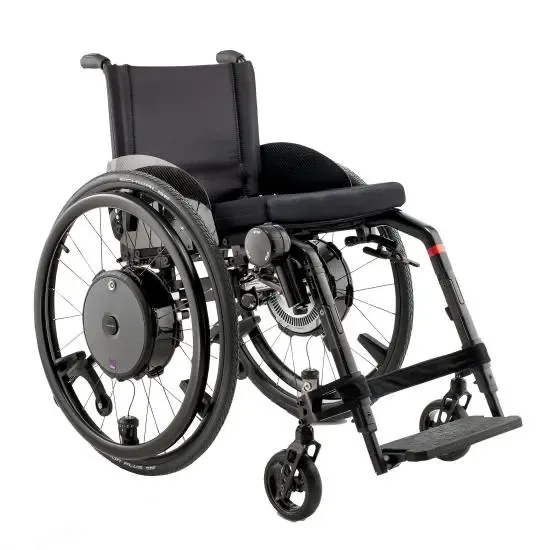
In this month’s blog I wanted to have a look at wheelchair equipment that is becoming increasingly in demand. That equipment would be power assist options. On the open market there is a huge variety of options all offering different solutions for the end user. I wanted to take time to think about some of the key advantages of power assist and why for some people it could be a better option than a powered wheelchair.
Power-assist systems can offer many of the advantages of a powered wheelchair while allowing a person to keep using their manual wheelchair.
Who may benefit?
Power assist is often useful for people who:
- Have limited upper-body strength
- Experience shoulder or arm pain
- Need to travel longer distances
- Have conditions such as multiple sclerosis, muscular dystrophy, arthritis, spinal cord injury, or fatigue-related disorders
The best option depends on the user’s strength, posture, environment, transport needs, and daily activities. A wheelchair assessment by a specialist therapist or wheelchair service can help determine whether power-assist wheels, a front attachment, or a full powered wheelchair is the most suitable choice.
If you are interested in power assist options please do get in contact with The Wheelchair OTs as we would be happy to hear from you.
Key benefits of power-assist systems
-
Easier propulsion
Power-assist wheels or add-on drive units provide extra motorised help when pushing, reducing the force needed to move the wheelchair, especially over longer distances.
-
Less strain on the shoulders and arms
Manual wheelchair users often experience shoulder, wrist, and elbow pain from repeated pushing. Power assist can significantly reduce the number and intensity of pushes required, helping to protect joints and reduce fatigue.
-
Better performance on slopes and uneven ground
Hills, ramps, grass, gravel, and thick carpets can be challenging in a manual wheelchair. Power-assist systems help users tackle these surfaces with less effort and greater confidence.
-
Increased independence
Users may be able to travel farther and participate in more activities without relying on assistance from others. Tasks such as shopping, commuting, or social outings can become more manageable.
-
Reduced fatigue
Many wheelchair users have conditions that affect strength or endurance. Power assist can conserve energy for work, study, family life, or leisure activities rather than using it all on mobility.
-
Maintaining the benefits of a manual wheelchair
Manual wheelchairs are often lighter, more compact, and easier to transport than full powered wheelchairs. Power-assist devices allow users to keep many of these advantages while gaining motorised support.
-
Flexibility in options
Different types are available including power-assist wheels that replace standard rear wheels, front-mounted power attachments that pull the wheelchair, and rear-mounted power units that push from behind.